




Apple Podcasts | Spotify
My 18-year-old son is obsessed with this brand. He’s old enough to buy whatever he wants, and he often opts for the toxic options, but this is one exception. Today, I’m sitting down to chat with Vincenzo Speroni, the Chief Sack Officer of Gotchies.
Vince didn’t set out to build a “non-toxic” brand. He set out to fix a problem he stumbled into as a broke college kid who felt fooled by his own Lululemon habit. What he built instead is an organic men’s underwear company proving that organic cotton, OEKO-TEX certification, and genuine comfort are the whole point.
If you’ve ever grabbed Skims just because it seems like the best “performance” option, this episode is for you! We don’t have to sacrifice comfort and performance in the name of toxin-free underwear.
How a College Kid With $1,000 in the Bank Started an Organic Men’s Underwear Company
Vince didn’t come into this with a background in textiles or a personal health crisis that pushed him toward “clean” living. He grew up around entrepreneurship, and he always knew he’d start something of his own.
While he was in business school with a job offer already lined up at a Big Four accounting firm, he was also running a weekly event with friends called Saturday Speeches. Instead of sleeping in on a Saturday, attendees showed up at 10 a.m. and gave a 7–10 minute presentation on any topic, to an audience they didn’t know in advance, on a topic no one else knew ahead of time either. I can’t imagine trying to get my kids to do that in college!
One Saturday, Vince’s topic was the negative health impact of synthetic clothing, specifically men’s underwear. He’d gone down a Reddit rabbit hole and learned, for the first time, what polyester actually was and realized the “high-quality” Lululemon pieces he’d been overspending on as a broke student were 100% polyester. Cheap to produce, marketed as premium.
That frustration became the pitch. The room, mostly men his own age, responded the same way: “This is frustrating, but what do we actually buy?”
Vince didn’t have an answer beyond “cotton, wool, hemp.” He didn’t know what GOTS certification was yet. But he recognized a problem most people didn’t know they had, and once they heard about it, they wanted a solution with no clear mainstream brand attached.
At 23, with about $10,000, he started building Gotchies, and that’s when he began researching what actually distinguishes clean fabric, landing on GOTS Certified Organic Cotton as the foundation of the brand.
Why “Normal Person” Design Beats Fashion-Industry Overthinking
Gotchies has resonated so strongly, especially with guys close to Vince’s own age, because they built the product the way a normal person evaluates underwear.
That meant skipping the elastic waistband with a logo pressed into it in favor of organic cotton wrapped around the waistband where it actually touches skin.
It meant not overthinking cuts or design trends and instead asking simple questions:
- Does it have the right amount of room?
- Can you work out in it?
- Can you sleep in it?
- Does the waistband itch?
The simplicity was the advantage. Gotchies was designed by someone trying to make organic men’s underwear that just works, and happens to be healthy fabric while it’s at it.
The Real Reason His Marketing Doesn’t Lean on Fear
Something I love about Gotchies is it doesn’t market itself with fear-based messaging. You won’t find “polyester is killing your health” language on the site, even though that kind of framing is common in the non-toxic space.
Vince was clear that this wasn’t accidental. Before he ever learned about polyester, he was already someone who exercised, ate clean, and tracked metrics like HRV and heart rate. Discovering that his underwear might be an issue felt like closing a gap in something he was already optimizing.
His logic: if you’re not exercising, sleeping well, or eating clean, your underwear is genuinely the least of your concerns. But once you’ve already handled the fundamentals and your radar for quality is up, switching your underwear becomes the next natural step.
That’s why Gotchies markets itself as an upgrade for people who are already paying attention to their health.
Pesticide-Laden Cotton vs. OEKO-TEX Certified Polyester: Which Is Actually Worse?
This is one of the most active debates in the clean-clothing space right now: is it better to wear 100% cotton that may have been treated with PFAS or formaldehyde-releasing finishes, or a polyester piece that’s OEKO-TEX certified and tested for chemicals?
This is Vince’s take: you can have polyester that isn’t especially toxic (setting aside broader environmental and plastic concerns), and you can just as easily have a “natural fiber” like cotton that’s been sprayed with pesticides and finishes. You think you’re getting a natural fabric, but you’re actually getting a pesticide-treated crop.
There’s also real debate around whether pesticide residue stays in cotton fiber through washing and processing. Vince used to assume it likely washed out.
Now that he works in the dyeing industry, specifically with a company doing botanical dyeing, he’s seen firsthand how chemicals become part of the fiber structure, and he no longer believes it reliably washes out. The science on this isn’t settled either way, though.
As for which is worse overall, it depends on your priorities. If you have an autoimmune condition or chemical sensitivities and you’re trying to minimize chemical exposure specifically, an OEKO-TEX certified polyester (tested and verified) might actually be the safer choice over an unknown cotton treated with undisclosed finishes, dyes, and possible heavy metals.
The Moisture-Wicking Myth, and Why Sweating Into Cotton Isn’t a Big Deal
Moisture-wicking is one of the most repeated marketing claims in activewear. Vince works with other companies trying to build cleaner activewear, and he’s noticed many of them shift toward Tencel instead of organic cotton specifically because customers complain about sweating through cotton.
But guess what? Humans sweat when they work out. That’s normal biology, not a flaw to engineer around.
He doesn’t personally mind sweating into cotton at all, and pointed out that most Gotchies customers report the same thing unprompted. His theory is that the entire “stay completely dry” standard was manufactured by synthetic textile marketing, not by any real biological need.
He also connected this to a related issue that polyester breeds bacteria, which is tied to complaints from customers about acne, dandruff, laundry odor, and general stink. Polyester is often the first thing he investigates when someone asks him what detergent to use for smelly laundry. The answer is usually less about the detergent and more about whether their clothing is synthetic in the first place.
“Moisture-wicking,” “odor-resistant,” and similar buzzwords usually just mean a fabric has been chemically finished without any real explanation of what that finish is or does.
Why There’s No Transparency in Clothing (And What’s Being Done About It)
If you buy something labeled 100% cotton, you genuinely have no way of knowing what’s been sprayed or finished onto it. Companies like Shein and Temu have inadvertently exposed that lead, formaldehyde, phthalates, and PFAS are showing up on imported clothing with zero disclosure.
Vince is involved with the Clean Clothing Coalition, which is working to pass ingredient transparency and textile regulation legislation through Congress.
In his experience, one of the biggest obstacles to this kind of regulation is pushback from the industry itself. Companies cite proprietary concerns to avoid disclosing dye processes, finishes, or manufacturing details.
What’s Next for Gotchies: Briefs Are Finally Getting Their Due
Roughly 21% of men wear briefs, but brief-wearers have largely been left out of the clean underwear conversation entirely.
If you prefer briefs and look for organic cotton options, you’re typically told to switch to boxers or boxer briefs instead because the options don’t exist.
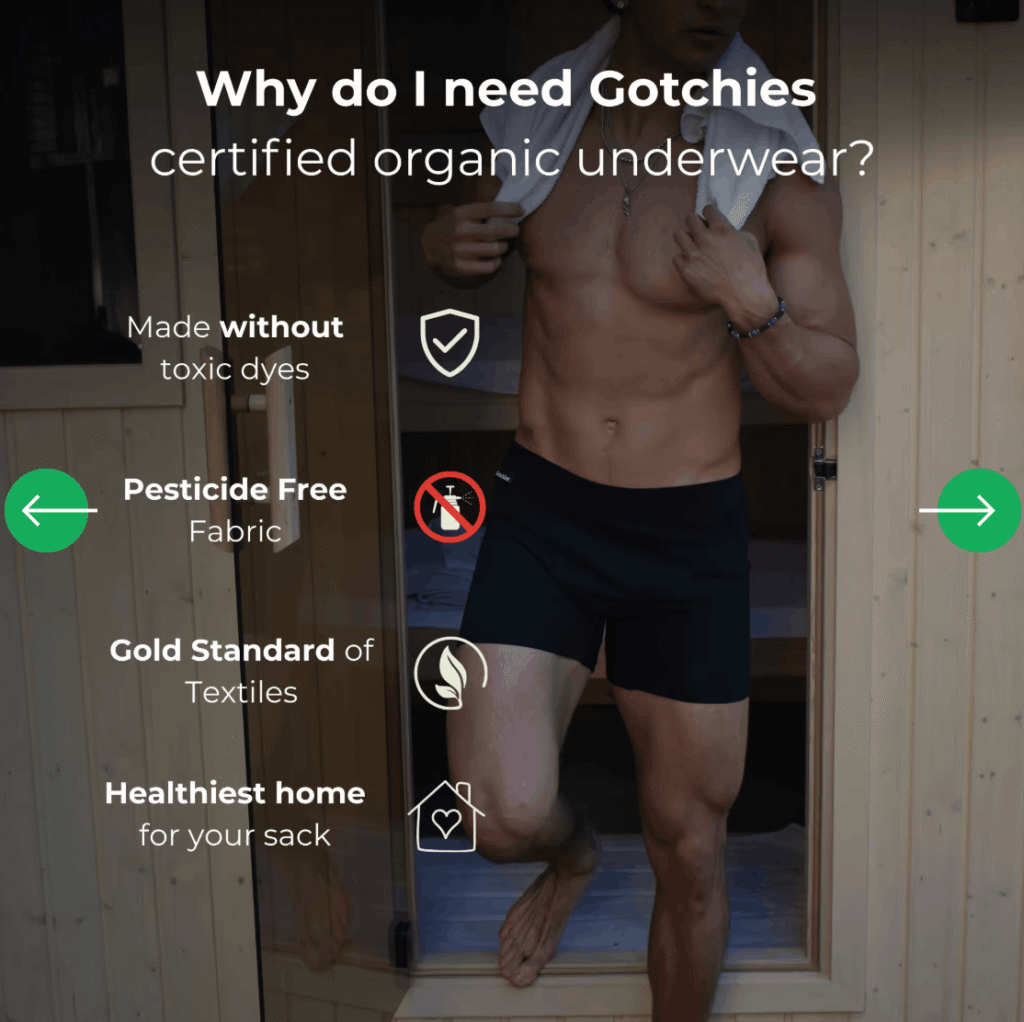
Gotchies briefs launched this month, alongside undyed boxers and navy blue boxers, with the rest of the product line restocking as well.
The Bottom Line on Comfortable, Organic Men’s Underwear
What stood out most to me in this conversation is that Gotchies isn’t trying to scare anyone into switching underwear.
Vince’s whole approach is built on the idea that clean and comfortable were never supposed to be a trade-off. He built a business out of personal frustration with feeling fooled by marketing, and ended up creating one of the only brands genuinely serving people who just want underwear that works and doesn’t come with hidden chemical baggage.
And as for my son — even with a room full of synthetic cologne and fluoride toothpaste, he’s stuck with Gotchies the entire time. Not because it’s “clean.” Because it’s the most comfortable underwear he’s ever worn. Which might be the best endorsement a non-toxic brand can get.
Shop Gotchies men’s organic underwear and use code WENDY15 for 15% off.
Related Episodes:
- Episode 65: From Harmful to Healing: AIZOME Leading the Way With Plant-Dyed, Synthetic-Free Textiles
- Episode 102: The Hidden Chemicals in Clothing: What Every Consumer Needs to Know with Hannah Dunning
- Episode 110: Polyester Underwear: The Hidden Fertility Factor in Your Underwear Drawer
- Episode 117: From the Front Lines: Changing the Toxic Textile Industry with Michel, Founder of AIZOME
IF YOU ENJOYED THIS WEEK’S EPISODE, PLEASE:
- Subscribe and leave a positive review or rating wherever you listen.
- Shop toxin-free products on my Toxin Free Shopping Guide—fully vetted by me and the very same brands that I bring into my home.
- Download this free guide on my top 25 toxins to avoid and how to spot them on labels.
- Post a screenshot, tell me what you loved, and tag me on Instagram @wendy_toxinfreeish.
- Get a deep-dive education on how toxins impact your health with Toxin Free in 3.

+ show Comments
- Hide Comments